
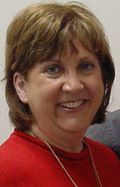
 Janice Kroger slowly unfolded the colorful, red-trimmed quilt, her hands gliding over the 26 blocks, all designed and stitched by men and women who have Parkinson’s disease.
“It shows we still can do things,” said the 60-year-old Columbus resident and former employee of the Indiana Farm Service Agency. “And I hope it brings awareness of the disease and support to fund research.”
The quilt, made by people across the U.S. and Canada, will travel to a Parkinson’s Disease Unity Walk April 24 in New York City’s Central Park and later to Glasgow, Scotland, for a world Parkinson’s conference.
Kroger created one of the blocks using butterflies to symbolize her memories of being free of the disease. Simple tasks, such as folding a quilt, used to be accomplished quickly and easily. Now, they take extra time and patience. “I can do whatever I want to do. It just takes a whole lot longer,” she said with smile.
Each block on the quilt tells a mini story about those afflicted with Parkinson’s. One block, for example, has a guitar to represent the person’s love of music. Others have hearts, flowers, birds and traditional quilt designs.
Together, the mostly novice quilt-makers with a common bond wanted to spread a message of hope.
The quilters also want to create awareness for the disease, which has gained more attention in recent years after the diagnosis of actor Michael J. Fox. Prize fighter Muhammad Ali also has become one of the more well known sufferers. Parkinson’s is a brain disorder in which certain nerve cells become impaired. The cells, which produce dopamine, allow smooth, coordinated function of the body’s muscles and movements.
Kroger said people often associate Parkinson’s with elderly people who have tremors, but she wants people to know the disease can affect anyone of any age, and symptoms vary.
“The quilt puts a face on the disease,” said Charlene Pryor of Vandalia, Ill.
Pryor suggested making the quilt and coordinated the effort by sending ideas and plain fabric squares to her friends who chat regularly on an online support group.
Pryor calls herself the “matriarch” of the Parkinson’s forum, where hundreds of people share information, concerns and hope for a cure.
When she suggested the quilt, Pryor immediately received positive feedback and volunteer quilters. Once all the blocks were collected, Pryor found someone to piece the quilt together and add decorative stitching.
“My grandmother told me there is nothing more comforting than a quilt,” Pryor said. “And Parkinson’s patients want nothing more than to be comforted.”
The quilt, she believes, inspires Parkinson’s sufferers and others.
“You can’t believe how people’s faces light up when they see it,” Pryor said.
Daily challenges
Pryor said those who are newly diagnosed often become depressed and go into semi-seclusion as they learn to cope.
Kroger, whose father also had Parkinson’s, said the online support group helped lift her and gave her renewed strength.
Kroger was diagnosed nearly 15 years ago after undergoing tests, visiting medical professionals and being told by one doctor all she needed was medication for anxiety.
At that time, she continued to work as a district advisor at the Farm Service Agency, where she looked out for the welfare of farmers and ranchers in Bartholomew County.
“You could always count on Janice to perform her duties in a timely and detailed fashion,” said Troy Hill, FSA county executive director. “She was self-motivated and enjoyed her work and the social interaction with our producers.”
Despite her dedication, Parkinson ’s disease forced Kroger to take disability retirement in 2006.
Although she still can drive and keep a part-time job with a local insurance agency, she has good and bad days.
She has to be patient with herself when her hands tremble uncontrollably, when she stumbles while walking and when her voice doesn’t have the power and strength it once had.
Kroger takes 29 pills a day, including five Parkinson’s medications plus vitamins and supplements.
Kroger, a mother of two and grandmother of four, wants nothing more than to help in the fight to find a cure.
She shares information about the disease wherever she can, including a recent presentation to a health careers class at Columbus East High School.
“I’m desperate for a cure because I don’t want anyone else to go through this,” Kroger said. “I don’t want my children or anyone else in my family to have this.”
One of Kroger’s sons, Bret Kroger, of Hope, said he tries to offer his mother encouragement and motivation.
“I tell her to remember she has Parkinson’s, and Parkinson’s does not have her,” he said.
Bret also said she is active with his two children, Clayton, 12, and Liz, 10. She likes working with them both in the garden, teaching Liz to sew and helping Clayton with computers.
Her other son, Bart Kroger, lives in Greensburg and has two children, Cierra, 15, and Tess, 10.
On days when she becomes frustrated, Kroger likes to write poetry on the computer. “I can’t write legibly anymore,” she said with a shrug.
Kroger also knows that to some degree she has to accept her fate.
She gets what she calls “sleep attacks,” during which she has to go to bed for hours before she can regain her strength. She also has to be careful about the timing of medications to control her shaking hands.
“You have to learn to listen to your body,” she said.
Pryor said the quilt was a tangible way for Parkinson’s patients like herself and Kroger to express their thoughts and hopes. Pryor also had all quilt contributors write a short story about their situations. The emotion came through on the quilt in the form of bright colors and thoughtful designs. “Every quilt square has a soul,” Pryor said. “You can touch it and feel it.”
—by Brenda Showalter, The Republic


