Thousands of farmers and rancher are being surveyed by the U.S. Department of Agriculture’s National Agricultural Statistics Service about their planting intentions for 2013. Results of the survey will help determine what to expect this growing season after last year’s drought. “The information we collect from producers during the first two weeks of March establishes a trend that we’re likely to see in the entire growing season,” said Bob Bass, NASS’ National Operations Division director. Most survey participants should have received a questionnaire in the mail this week and can submit responses online or by mailing the completed forms. Learn more.
Robots Could Annihilate ‘Superweeds’
Placing robots on the farm is not a new idea, but researchers at the University of Nebraska are hoping to develop one that will combat “superweeds” that are growing resistant to many herbicides. The robot would roam the fields and individually treat each weed. According to researchers, this would stop producers from making multiple herbicidal applications that are the cause of herbicide-resistant weeds and contribute to chemical runoff into waterways. Read more (NPR). annihilation
Snow Storms Bring Some Relief to Drought-Stricken Areas
Farmers in the Great Plains are welcoming the barrage of snowstorms blanketing the area. Although livestock may be stressed, the moisture is bringing relief to one of the worst droughts in U.S. history. Rain and snow left up to 18 inches in portions of the Midwest, providing a good start for the winter wheat crop. More water may be needed to nurture the upcoming planting of corn and soybeans, but that’s not a big issue according to one agricultural meteorologist, who stated that more rain is expected to move into the Northern Plains and dry areas of the Midwest next week. Read more (Reuters).
Latest Edition of MIDAS Press Focuses on Final Stages and Training Efforts
MIDAS is in the final testing stages for the farm records deployment and soon will start scheduling training for super users, state trainers and end users, according to the latest issue of MIDAS Press. The 2013 winter edition highlights the progress made over the past three months, including the introduction of hyper care — a stabilization period that takes place once the system goes live and focuses on customer support, data integrity, and system availability — and training and workshop events. Read the MIDAS Press.
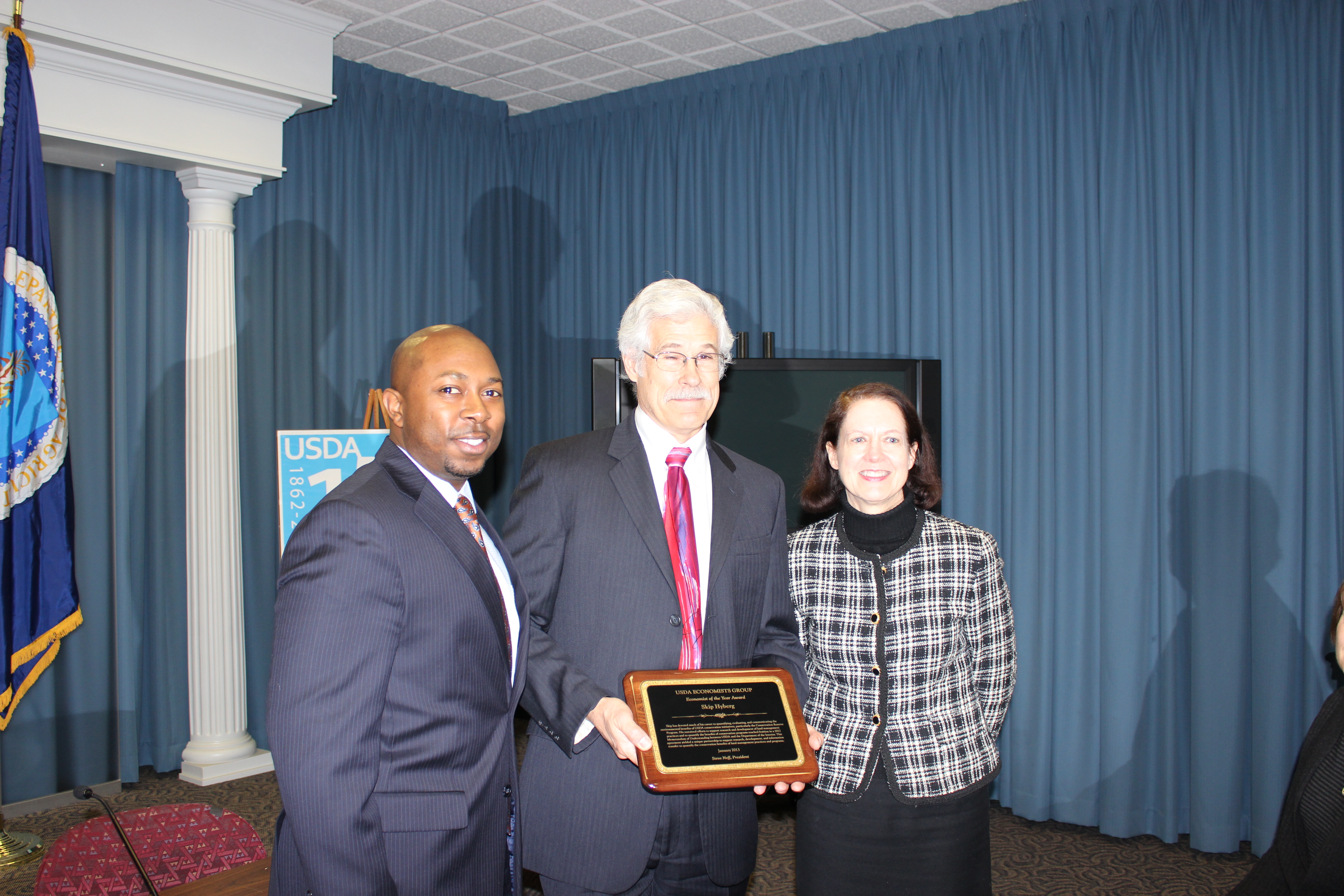
Skip Hyberg Honored With Economist of the Year Award

Karis T. Gutter, deputy undersecretary, FFAS (left), and Joy Harwood, director, Economic Policy Analysis Staff (right), present the Economist of the Year Award to Skip Hyberg.
He is a quantitative and scientific force behind the nation’s largest conservation program.
Armed with two doctoral degrees, Skip Hyberg is an economist and a scientist who has linked both of those worlds together to design and implement the Farm Service Agency’s Conservation Reserve Program (CRP).
For nearly a decade’s worth of work invested into the monitoring, assessment and evaluation of the CRP program, Hyberg was awarded the 2013 USDA Economist of the Year Award.
“I was pleasantly surprised,” said Hyberg, about his nomination. “I know a lot of very good economists in USDA who have done a lot of good work. It’s great to be nominated with such a distinguished group.” Continue reading
Man-Made Risk Creates Uncertainty in Agriculture, Rural America
With record farm income, record exports and more young people moving into agriculture, the entire field of agriculture is becoming cool again. So what risk do we need to manage?
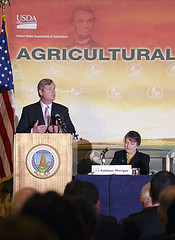
That’s the question Agriculture Secretary Tom Vilsack asked during his keynote address at the Agricultural Outlook Forum, on Feb. 21 in Arlington, Va. Following the theme, “Managing Risk in the 21st Century,” Vilsack said there is risk we don’t have control over and then there is man-made risk.
“The uncertainty and risk in ag today in many cases are man-made,” said Vilsack. “There is risk in the uncertainty… of the pending sequester. What that means for USDA is that every line item will have to be reduced by about five to six percent. The only way we can absorb a cut of this magnitude is by impacting the people,” said Vilsack. Continue reading
Animal Health Organization Recommends U.S. BSE Risk Status Be Upgraded

Agriculture Secretary Tom Vilsack announced a change to the U.S. risk classification for mad cow disease during the Agricultural Outlook Forum.
Agriculture Secretary Tom Vilsack announced today that the United States’ risk classification for bovine spongiform encephalopathy — also known as mad cow disease — has been recommended for an upgrade to negligible risk. The announcement came as part of the keynote address during the Agricultural Outlook Forum, held Feb. 21-22 in Arlington, Va.
Vilsack received the information from the World Organization for Animal Health (OIE) that recommended the classification be changed based on the actions taken to manage risk of the disease. The OIE Code, which is based on the latest science and current knowledge concerning BSE, provides guidelines for the safe trade of animals and products based on the country’s risk status and the risk presented by the specific item being traded. Negligible risk is the lowest risk level under the OIE Code. Continue reading
Ag Outlook Forum Jumps Off on Positive Note
The Agricultural Outlook Forum kicked off on a positive note today as USDA Chief Economist Joseph Glauber told attendees that despite the historic drought, the agriculture economy is very strong. Producers saw a record high in net cash income last year and are expected to reach near record highs in 2013.
“It sounds a lot like déjà vue. You’ve heard this before,” said Glauber of the similarity to last year’s forecast. “But with drought issues, there will be a lot of people watching data.”
Glauber said 2013 forecast is expecting a rebound in yields and record production in corn and soybeans. Continue reading
Study: Irrigating Portion of Cotton Field Could Maximize Yield
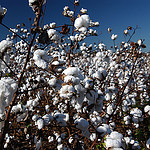
As drought continues to grip portions of the country, researchers from Texas Tech University and the USDA Agricultural Research Service are determining whether producers can maximize cotton yield by watering only a portion of their field. Results showed that watering 30 to 70 percent of a cotton field produced the most yield and profit, depending on available irrigation water. Cotton can be grown as a non-irrigated crop and still produce an adequate crop three out of five years under those conditions, according to researchers. Read more or view the abstract.