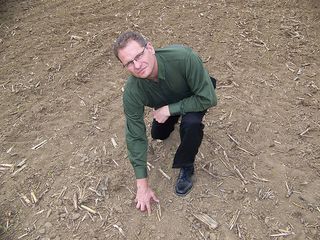
Jessica Hula-Fredericks has lived and breathed dairy most of her life. At age 23, when milk prices plummeted, Hula-Fredericks went to the Farm Service Agency in Marcy, N.Y. for a beginning farmer loan. “I said I wanted 100 cows and to start milking in a month. They made it happen.” That was three years ago. Today, she owns 129 cows and 97 head of young stock. Read more (Lancaster Farming).
FSA Loan Launches 23-Year-Old Into Dairy Farming
The Future of BCAP in Discussion
One of the policy issues in debate as Congress wrestles with a new Farm Bill is what to do with the various energy sections.
The 2008 Farm Bill produced an incentive program that the Farm Service Agency (FSA) administered. It was designed to generate a start-up of crops that could be used for cellulosic fuel production and encouraged the collection of waste cellulosic materials for similar purposes.
The Biomass Crop Assistance Program (BCAP) initially focused on the latter solution, providing incentives for the collection, harvest, storage and transportation of secondary materials. Incentives to grow grasses and trees that could be renewable sources for energy production came later, but also at a time when Congress sought ways to reduce funding because of budget concerns.
USDA, Arkansas Collaborate to Benefit Illinois River Watershed
The USDA Commodity Credit Corporation and the state of Arkansas entered into a revised agreement to add incentives to the Illinois River Watershed Conservation Reserve Enhancement Program (CREP). The program was created to reduce nutrient, bacterial and sediment load in the Illinois River Watersheds. The agreement establishes riparian buffers and filter strips on marginal pastureland and cropland with a goal of reducing 85,000 tons of annual sediment loading into local streams and waterways. “USDA is proud to work with the state of Arkansas to enroll up to 10,000 acres of eligible cropland and marginal pastureland to enhance the water quality, biological diversity and aquatic habitats of the Illinois River Watersheds,” said FSA Administrator Bruce Nelson. Learn more.
Female Producers Take Over Farm
More and more women are taking over the farm. For some, it’s by choice. For others, it’s a matter of keeping the land in the family. In 2007, about 14 percent of farms were owned by women. As that demographic starts to change, more opportunities are available to help women manage a farming operation. (NPR).Listen to more
Competition Unearths New Public Service Announcement
An FSA-wide competition exposed the creative minds of 25 employees to create this year’s Earth Day public service announcement. PSA submissions came from every region of the country enveloping artistic genres that ranged from poetry to rap. Yet, only one could win. Well, actually three. Congratulations to Mardell Ferguson, Stanton, Neb.; Monica Short, Jackson, Miss., and; Tia Walke, Chesapeake, Vir. The judges used a portion from each of these winning submissions to create the final product. Special recognition went to Laura Crawford, Heather Helterbrand and Lisa Houser in Chillicothe, Ohio for a unique song, and Cynthia Walthers and Brian Ranck in Harrisburg, Pa. for an Earth Day rap. Listen to the PSA.
CRP Film Wins Telly Award
Congratulations to the Farm Service Agency for winning a bronze Telly Award for the production of the film “The Silver Lining — 25 Years of the Conservation Reserve Program.” The Telly Awards recognize the best film and video productions, web commercials, and local, regional and cable TV commercials and programs. Kent Politsch, chief, FSA public affairs, accepted the award on behalf of the organization on April 18 during a showing of the film at USDA headquarters in Washington, D.C. The 15-minute presentation documents the birth of CRP in 1985 and highlights improvements the program has made by providing better air and water quality through reduced soil erosion. It also points out how the program has created an improved habitat for wildlife.
A Country Boy’s Journey: Willie Cooper Celebrates 40 Years as SED
By Willie F. Cooper, FSA State Executive Director for Louisiana
April 16, 2012, was a memorable day for Willie F. Cooper, state executive director (SED) for the Louisiana Farm Service Agency. Yesterday marked 40 years as SED for FSA and the former Agricultural Stabilization and Conservation Service (ASCS). In August, Cooper will celebrate 55 years of total service to USDA. Prior to his appointment, Cooper had worked as a field reporter, county office trainee, county executive director, county office reviewer, assistant administrative chief and chief of the Administrative Division. Recently, he provided some thoughts and memories on his tenure.
Many people ask why I am still working. I cannot give a good answer to that question. I guess I must enjoy it and enjoy the challenge. I have been blessed with the privilege of working with some wonderful employees, state committee members, farm groups, and the Louisiana Congressional delegation. And I have seen the many benefits that FSA has provided to producers throughout the years.
Local Spotlight: Greene/Sumter County FSA Ready to Assist
With a combined total of 2,655 producers served, the Greene/Sumter County Farm Service Agency County Office in Alabama is always on its toes ready to assist. Greene County is highly populated with catfish, timber and beef cattle. Other crops include cotton, soybeans, shrimp and corn. Next door is Sumter County. Known for its beef, catfish, forestry and forages, nearly 70 percent of Sumter County’s 921 square miles is forested. True to rural America, most of its residents rely on agriculture as a main source of income.
The Greene/Sumter County FSA welcomed a new county executive director last December. Alex Crawford, III, began his career with the agency six years ago as a program technician. For a short time he was county executive director in Mobile and was then transferred to the Montgomery State Office as a management and program analyst in 2010.
Eager to Plant: Farmers Weigh Risks of Unseasonably Warm Spring
Of the many factors that make farming risky, weather is particularly important. With this year’s unseasonably warm March, some farmers are taking a risk they hope pays off in a big way. Despite the peril of a spring frost, many farmers are planting corn almost a month earlier than the usual mid-April planting dates. As they wait to see what happens with the weather, these farmers, along with analysts, policymakers and others interested in U.S. agriculture, will pay close attention to the Crop Progress report issued weekly by USDA’s National Agricultural Statistics Service. Read more (USDA blog).
CRP Sign-Up Ends Tomorrow
Producers have one day left to sign up for the Conservation Reserve Program. CRP is a voluntary program available to agricultural producers to help them use environmentally sensitive land for conservation benefits. Producers enrolled in CRP plant long-term, resource-conserving covers to improve the quality of water, control soil erosion and develop wildlife habitat. In return, USDA provides participants with rental payments and cost-share assistance. Those interested must submit an application by April 13. Read more.