The USDA Commodity Credit Corporation, which helps stabilize, support and protect farm income and prices, released interest rates for July 2013. The borrowing rate-based charge is 0.125, which is unchanged from June 2013, while the 1996 and subsequent crop year commodity and marketing assistance loans dispersed during July is 1.125, unchanged from last month. Interest rates for Farm Storage Facility Loans and discount rates for the Tobacco Transition Payment Program also are available. Read more.
Commodity Credit Corporation Releases Lending Rates for July
Survey Shows Colony Collapse Small Factor in Winter Bee Loss
Honey bee losses continue to decrease, but it’s not all due to colony collapse, according to a survey funded by the U.S. Department of Agriculture. Total bee losses for the 2012-2013 winter were 31.1 percent for all causes. That number is slightly higher from last year’s number that stood at 22 percent. Based on the survey, more colonies dwindled away instead of suffering from Colony Collapse Disorder that causes a sudden loss of a colony population. The survey noted that beekeepers who took honey bees to California to pollinate almonds reported a 50 percent or higher colony loss than those who did not. Learn more.
USDA Selects 2013 Class of Garza Fellows
The U.S. Department of Agriculture has selected 10 individuals to be a part of the 2013 E. Kika De La Garza Fellowship Program. The fellows represent staff, faculty and administrators at Hispanic-Serving Institutions (HSI) from across the nation. HSIs are accredited and degree-granting institutions of higher education with a full-time Hispanic student enrollment of 25 percent or more. Through partnerships fostered by the fellowship program, USDA and HSIs are better prepared to address educational challenges faced by the Hispanic community The program allows fellows to experience first-hand the policymaking process by meeting with USDA personnel and connecting with federal agencies while also collaborating with leading scientists from USDA’s Agricultural Research Service and learning about agricultural research. Learn more.
Rent-A-Goat Chews Up Invasive Plant Species
Ben Robel’s goats are in demand. Owner of Vegetation Solutions, the 28-year-old rents his goats to Wisconsin landowners to munch on brush and chew away invasive plants like buckthorn, sumac and prickly ash. The hungry animals eliminate the need to spray herbicides and their manure helps fertilize the land. Read more (LaCrosseTribune.com).
Never Before Seen Piglet Virus Spreading Through U.S. Farms
A piglet virus that has never been seen before in North America has hit almost 200 farm sites in 13 states. Known as Porcine Epidemic Diarrhea Virus, or PEDV, it causes diarrhea, vomiting and dehydration in piglets. Older pigs can be affected, but their survival rates are higher. Iowa, Oklahoma, Minnesota and Indiana have the most reported cases, but there are cases in other states including Arkansas, Kansas, Ohio and Pennsylvania. The virus is almost identical to PEDV found in China in 2010 that killed more than 1 million piglets. The virus does not pose a risk to humans or other animals and the meat from PEDV-infected pigs is safe for human consumption. Read more (Reuters).
USDA Pilots New Annual Forage Insurance Plan
The U.S. Department of Agriculture is piloting a new federal crop insurance plan that uses a rainfall index to provide coverage for annual forage crops. The Rainfall Index Annual Forage Insurance Plan is being tested in six states and covers crops planed annually and are used for livestock feed or fodder. All counties in Texas, Oklahoma, Kansas, Nebraska, South Dakota and North Dakota are eligible to participate. The plan does not use actual crop production, but a rainfall index to insure against a decline based on long-term, historical precipitation value for a specific area for the same time period. Producers interested can decide whether the plan is right for them by using a decision support tool on the USDA Risk Management website. Crop insurance is sold and delivered through private crop insurance agents. Contact a local crop insurance agent for more information. Learn more or use the decision support tool.
Grants Available for Weather-Damaged Connecticut Farms
Connecticut farmers who suffered unrecoverable losses in production and property damage in 2013 due to severe weather events are eligible for grants to help recover and rebuild. Sponsored by the Connecticut Department of Agriculture and the Department of Economic and Community Development, a total of $5 million has been designated for the grants, with individual awards given based on the number of qualifying applications received by the July 15, 2013, deadline. “Over the last two years, our state’s farm sector endured a series of severe weather-related blows that have put many of their businesses in peril,” said Governor Dannel P. Malloy, who announced the awards this week. “I am committed to helping these hard-working families recover their losses and to seeing Connecticut’s small farms succeed and thrive.” Learn more.
Little People’s Garden Teaches Big Life Lesson
Give a man a fish and you feed him for a day. Teach a man to fish and you feed him for a lifetime. This Chinese proverb is the idea behind the Little People’s Garden in Montevideo, Minn.
“Children need to know where their food comes from,” said Liz Ludwig, Farm Service Agency county executive director “It’s not made in a factory; it’s grown in the soil, raised by farmers and ranchers, and cared for by people we call farmers.”
Initiated by Ludwig, the Little People’s Garden — now in its fourth year — was planted at Kinder Kare learning center in Montevideo, providing preschoolers a hands-on opportunity to learn where their food comes from and how to make healthy food choices. Continue reading
N.C. FSA Office Offers a Little Worldly Advice

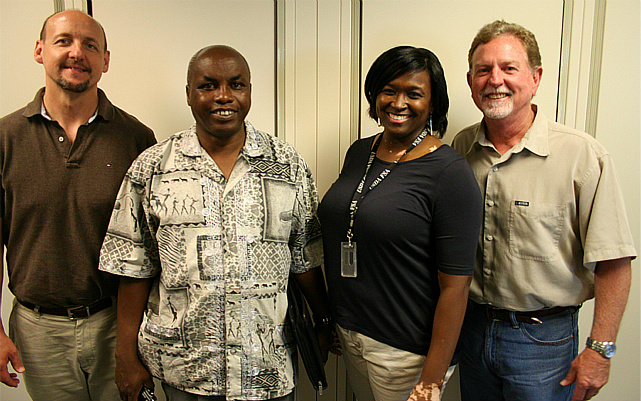
David Tonui (2nd from left), visits with North Carolina State Office staff members (pictured l to r): Victor Youngblood, Alisha Bridges and Tim Jones.
By North Carolina Farm Service Agency Office
Kenyan school leader David Tonui visited the North Carolina Farm Service Agency as part of a visit to the United States to research how farm communities function.
“Tonui was amazed at the programs FSA has in place to supports agriculture in the United States,” said Eddie Woodhouse, FSA public affairs specialist in North Carolina. He was especially surprised about the conservation programs, disaster assistance, and backing for beginning farmers. “My country (Kenya) does not have the level of support for farming you [FSA] provide to your producers,” said Tonui. “Unpredictability deters farmers from expanding. A disaster often eliminates a farmer’s setup. In America, a weather crisis suspends, but does not end, a farmer’s operation.” Continue reading